
Implementation
Sports Betting AI: What It Really Means for Player Support

Last updated 10 August 2026
Sports betting AI is software that applies machine learning and language models to three distinct jobs inside a sportsbook: pricing and risk on the trading side, discovery and personalization on the player-facing side, and resolution on the support side. For customer support specifically, it means something concrete. An AI system reads a player’s question, pulls their real account and bet history, and either resolves the issue outright or hands it to a human with full context.
Most explanations of “sports betting AI” never get this specific because they collapse three different technologies into one buzzword. A trading model that reprices a live market has almost nothing in common with a support agent that settles a disputed bet. The two share little beyond the letters “AI.” For an operator deciding where to invest, the distinction is the entire point.
This article focuses on the third job — support — and what it takes to do it well when the customer is a real-money bettor and the clock is running.
What sports betting AI means
Strip away the marketing and “sports betting AI” describes any system that learns patterns from betting data to make or assist a decision. Specifically, three families of decisions matter to an operator. First, trading AI sets and adjusts odds, manages liability, and flags suspicious wagering. Second, discovery AI recommends markets, personalizes the sportsbook lobby, and surfaces bets a given player is likely to want. Finally, support AI handles the conversation after the bet is placed — the settlement query, the withdrawal that hasn’t landed, the bonus that didn’t trigger, the identity check that stalled a first deposit.
These are not variations on one product. Instead, they run on different data, answer to different owners inside the business, and fail in different ways. For example, a trading model that misprices a market costs money directly, while a support model that misresolves a self-exclusion request costs a license. Treating them as one category is therefore the first sign a vendor has not thought hard about any of the three.
The support job is the one most operators underestimate, because on the surface it looks like generic customer service with a betting skin. It is not. In practice, the queries are time-boxed, the answers are financially and legally consequential, and the player on the other end is often mid-session, watching a game, and expecting an answer before the next market closes. This is the part of sports betting AI that most directly shapes whether a player stays or churns.
The three layers of sports betting AI: odds/trading, player-facing discovery, and back-office support
Think of a sportsbook as three stacked layers, each with its own AI:
Trading and odds AI: prices markets, manages liability, and flags suspicious wagering.
Player-facing discovery AI: recommends markets, personalizes the lobby, and surfaces bets a player is likely to want.
Back-office support AI: resolves the conversations that follow a bet, including settlements, withdrawals, bonuses, and verification.
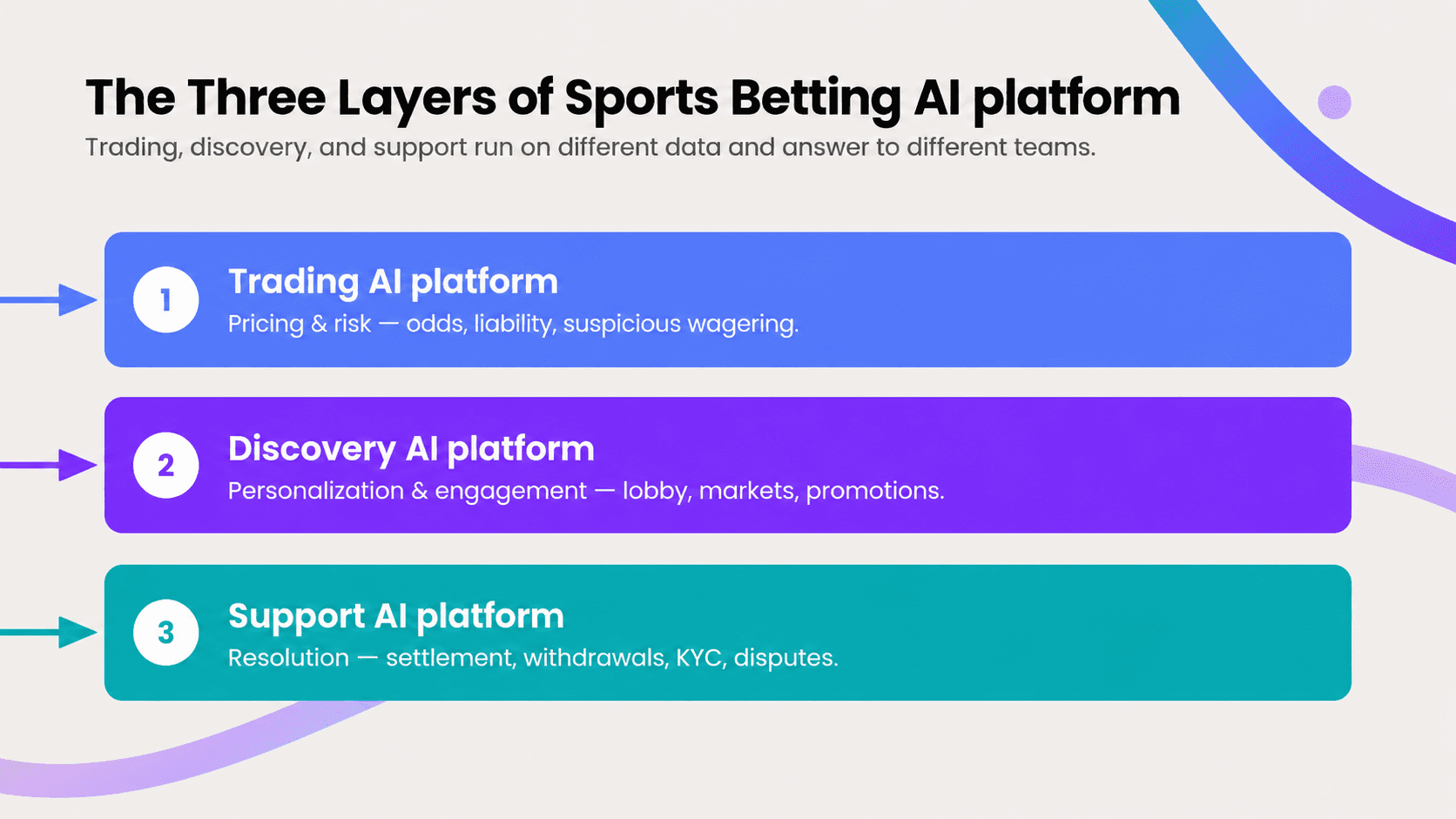
The three layers of sports betting AI: trading, discovery, and support
The trading layer
The trading layer is where most of the industry’s AI investment has historically gone. Specifically, models ingest historical results, live match data, and market movement to price thousands of markets and manage exposure in real time. This is the layer that keeps the book balanced. Overall, it is highly quantitative, largely invisible to the player, and owned by trading and risk teams.
The discovery layer
The discovery layer sits between the book and the bettor. In practice, it decides what a player sees when they open the app: which markets lead, which accumulators get suggested, which promotions surface. Its goal is engagement and, downstream, lifetime value. Notably, it is owned by product and CRM teams and increasingly uses the same recommendation techniques as streaming and e-commerce.
The support layer
The support layer is where the player goes when something needs fixing or explaining. “Why was my bet settled as a loss?” “Where is my withdrawal?” “Why can’t I deposit?” This layer used to be pure headcount — contact centers, scripts, escalation tiers. It is where support-resolution AI now lives, and it is the layer with the sharpest operational and compliance stakes, because every interaction touches money, identity, or player protection.
The reason this framing matters commercially
A vendor strong in one layer is not automatically credible in another. A trading-model provider does not know how to settle a bonus dispute inside a compliance boundary, and a horizontal support platform does not understand a cash-out timing complaint. When you evaluate “sports betting AI,” decide which layer you are buying for first.
There is also a strategic reason the support layer is where the next round of competitive advantage sits, and it is not a technology reason. Trading edge is well understood and heavily contested; every serious book has strong pricing. Discovery, similarly, is converging on the same recommendation playbook everyone else uses.
Support, by contrast, is the layer where operators still differ enormously. Some resolve a settlement dispute in minutes. Others take days and lose the player in the gap. As a result, it is also where the cost base is largest and least examined. For a commercial leader, that combination — large cost, wide performance spread, direct effect on retention — is exactly where an investment in sports betting AI moves the P&L.
In short, player lifetime value is made or destroyed in the moments a bettor is frustrated and waiting, and the support layer owns those moments.
Where support-resolution AI fits vs. betting-engine AI
The confusion worth clearing up is this: betting-engine AI and support-resolution AI are frequently sold under the same “sports betting AI” headline. As a result, buyers often assume competence in one implies competence in the other. It does not.
Two jobs, not one
Betting-engine AI is optimized for prediction and pricing. Its output is a number: an odd, a limit, a risk score. It succeeds when the book stays balanced and sharp bettors are identified early. Notably, it has no conversation with the player and no obligation to explain itself in plain language.
Support-resolution AI, however, is optimized for understanding and action inside a conversation. Its output is a resolved issue and, ideally, a satisfied player. Specifically, it has to read intent from a frustrated one-line message, retrieve the specific facts of that player’s account, and decide whether it can act. It then takes the action or escalates, all while staying inside rules that vary by jurisdiction and product.
The two share no meaningful engineering. For example, a model that predicts match outcomes cannot settle a disputed each-way bet, and a model that resolves a withdrawal query has no view of live liability. When an “AI for sportsbooks” pitch blurs the two, it is usually because the vendor is strong in one and hoping the halo covers the other. For a support decision, therefore, ignore the trading credentials entirely and evaluate the support capability on its own terms.
The practical vendor test
A useful test for a buyer is to ask the vendor to walk through a single support contact end to end, such as a settlement dispute, and watch where the answer gets vague. A trading-first vendor will describe the model architecture and the data science, but will never truly resolve the player’s question. A support-first vendor, in contrast, will describe how the system reads the bet, checks the rule, and decides whether it can answer. It will also explain when the system escalates. In short, the category label on the pitch deck tells you nothing; the walkthrough tells you everything.
Why sportsbook support has sharper time-pressure and compliance stakes than generic AI support
Generic AI support, the kind that answers “where is my order” for a retailer, operates with slack. A late reply annoys a shopper, but it rarely breaks a rule. Sports betting AI built for the support queue has neither the slack nor the low stakes.
The time pressure is structural. For instance, a player disputing a cash-out value is often mid-event, and the market they care about closes in minutes, not days. Similarly, a withdrawal query carries emotional weight that a delayed parcel does not.
On top of that, the compliance stakes are constant. A large share of support contacts touch KYC, payments, bonus terms, or responsible-gaming signals, any of which can turn a routine ticket into a regulatory event. The same message, “I want to close my account,” can be a churn risk or a self-exclusion request that carries legal obligations. Generic support AI is not built to tell the difference, and in a licensed market, that gap is the whole risk.
The sportsbook-specific support queue: bet settlement, live odds disputes, cash-out timing, account verification
Look at what lands in a sportsbook support queue and you see why horizontal tools struggle. Four contact types dominate it:
Bet settlement disputes are the hardest. A player insists a bet won; the settlement says it lost. Resolving it correctly means reading the specific market, the actual result, the bet type, and the operator’s own settlement rules, then explaining the outcome in language a frustrated player will accept. Get it wrong in the player’s favour and you leak margin; get it wrong against them and you generate a complaint, possibly a regulatory one.
Live odds disputes are time-critical. A player claims the price moved between selection and confirmation. The window to investigate and respond is short, and the answer depends on timestamps and market state the support system has to see.
Cash-out timing complaints combine impatience with real money. “I tried to cash out and it didn’t go through” needs an immediate, accurate read of what happened to that specific bet at that specific moment.
Account verification (KYC friction) is where first deposits die. A player whose identity check stalls will abandon the deposit, and often the account. Resolving it fast, without violating the verification rules, is worth real revenue.
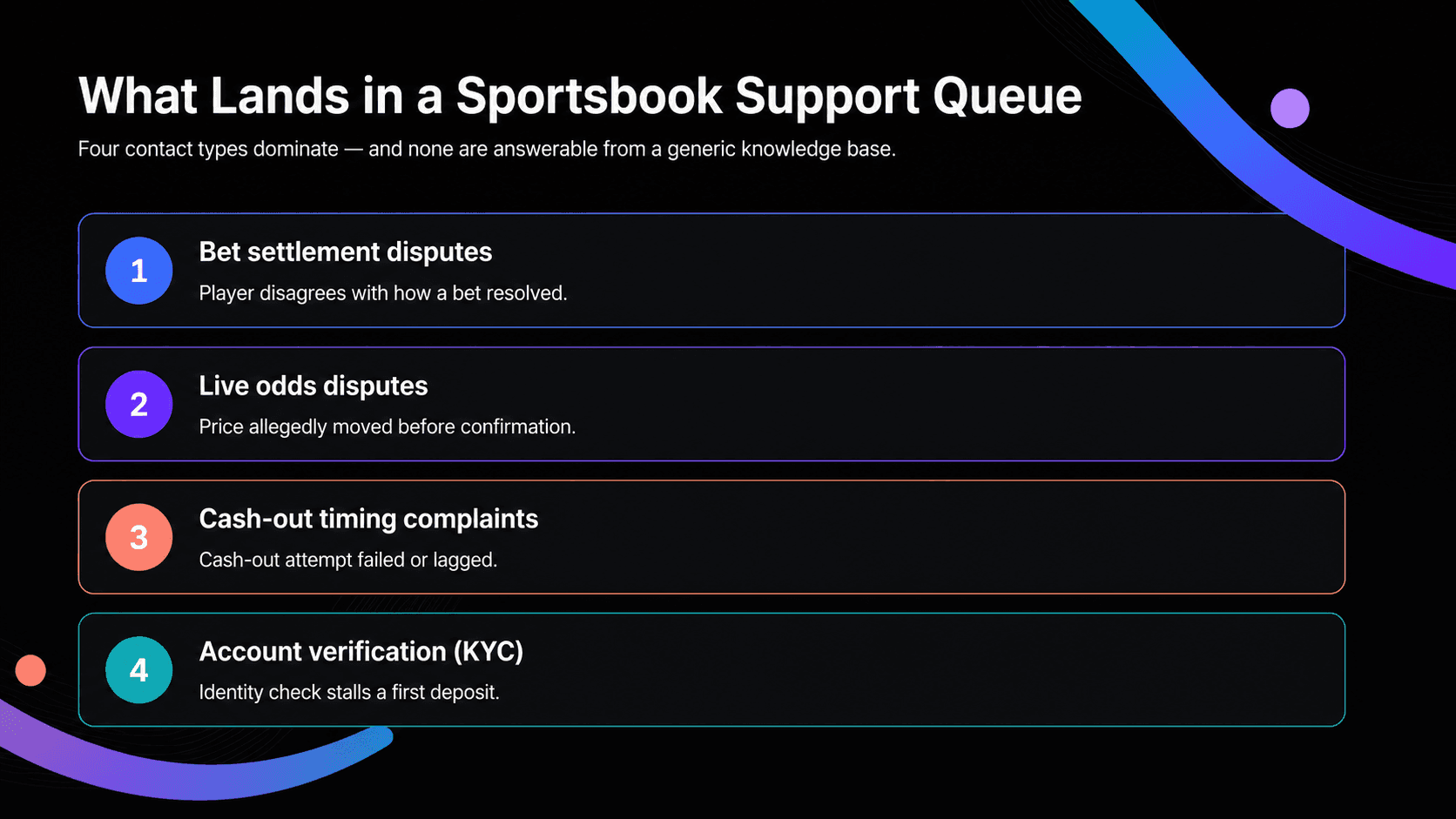
What lands in a sportsbook support queue: bet settlement, live odds disputes, cash-out timing, and account verification
None of these are answerable from a generic knowledge base. Each needs live account context, product-specific rules, and a clear escalation path when the AI should not decide alone. In short, that combination of context, rules, and judgment about when to stop is what separates support-resolution AI built for sportsbooks from a chatbot with a betting FAQ.
A concrete example
Consider one case. A player places a same-game accumulator during a Saturday football fixture, tries to cash out in the 78th minute as their team leads, and the cash-out fails. Minutes later the lead is gone and the bet loses. The player then contacts support, convinced the platform robbed them.
Resolving this well requires the system to pull the exact bet and read the cash-out attempt and its timestamp. It also has to understand why the cash-out failed, for instance a suspended market during a goal-line incident, and explain that in language that de-escalates rather than inflames. All of this has to happen within a few minutes, because the player is angry and public complaints spread quickly.
A generic tool sees an unstructured angry message and, at best, routes it to a queue. A sportsbook-trained system, however, recognizes the pattern, retrieves the facts, and either resolves it or hands a human the full picture. The commercial stakes are visible in that single interaction: handled well, the player stays. Handled slowly or wrongly, you lose the account and possibly the reputation, one screenshot at a time.
How Raphie’s AI platform + CoPilot model handles this queue
As a sports betting AI system, Raphie approaches this queue as two coordinated modules rather than one bot, built around the Raphie AI platform. The AI resolves contacts end to end where it can do so safely. Meanwhile, the CoPilot sits alongside human agents, drafting responses and surfacing account context in real time so a person resolves faster without losing control. The underlying design assumption is that some contacts should never be fully automated, so the system is built to know which.
Proof points at a glance
The numbers Raphie reports for the AI platform module reflect that resolution-first design in this sports betting AI deployment (human industry-standard baselines shown for comparison):
True resolution: ~74% of tickets fully handled by Raphie
CSAT: ~88%
Average handle time: ~5 minutes
Wait time to first response: ~20 seconds
First reply time: ~10 seconds
Player replies per resolved inquiry: ~3
In addition, Raphie’s own internal benchmarking against two unnamed generic AI systems (N = 5,042 handled queries) found that Raphie resolved roughly twice the rate and showed about 3.5x lower abandonment. Its conversations were also shorter and clearer rather than longer.

Raphie vs. human baseline: CSAT, average handle time, first reply time, and player replies per resolution
Two things make those numbers possible in a sportsbook context specifically. First, domain training: Our AI platform is trained on five-plus years and over a million real iGaming interactions from Raphie’s own CX operations. As a result, it recognizes a settlement dispute or a cash-out complaint as what it is, not as generic text. Second, the CoPilot/Agent split gives the operator a proving ground. Specifically, CoPilot assists humans first and builds an evidence trail, before the Agent takes contacts autonomously. That, in practice, is how you get resolution numbers without betting the license on day one.
Resolution, not deflection
The word doing the work above is resolution, not deflection. A deflected contact is one the player gave up on. A resolved contact, however, is one that ended with the issue fixed. In a queue full of settlement and payment disputes, that difference is the difference between a quiet complaint file and a clean one.
The commercial model
The commercial model is built around that same word. Raphie prices on outcomes: when a human resolves the contact instead of the AI platform, there is no charge for it. That structure only makes sense for a vendor confident in genuine resolution. It also aligns the vendor’s incentive with the operator’s, since the vendor earns when the issue is truly fixed by the AI, not when a ticket is merely opened or contained.
Positioned in the right rollout, Raphie frames the AI platform and CoPilot together as capable of reducing CX costs by 60% or more. However, that figure is a business-case outcome to model against your own volumes, not a blanket guarantee. For a commercial leader, the honest way to read it is as the top of a range you validate during the proof-of-concept, with outcome-aligned pricing capping your downside if resolution comes in lower.
Built for control, not just speed
There is also a control dimension that matters to anyone carrying brand risk. Because CoPilot proves the system on real contacts while a human stays in the loop, an operator can watch resolution quality accumulate before handing the Agent autonomy. In other words, you are not asked to trust a number in a pitch deck. Instead, you run the model against your own queue for ten weeks and read the result. That sequencing, prove then scale, is the part most horizontal vendors cannot offer, because they were not built to sit behind a human first. For examples of that sequencing in practice, see Raphie’s client case studies.
Raphie vs. horizontal support platforms on sportsbook-specific criteria
The table below compares Raphie against generalist, horizontal CX platforms on the criteria that matter for a sportsbook support queue. Figures for Raphie are our own approved measurements; nothing here represents an independently verified benchmark of any other vendor.
Criterion | Raphie | Horizontal support platforms |
Vertical focus | Built exclusively for iGaming: OSB, iCasino, wagering | General-purpose CX across industries |
Public performance claim | ~74% true resolution, ~88% CSAT (Raphie’s own approved figures) | Varies; commonly framed as deflection/automation |
Resolution vs. deflection framing | Resolution-first (issue fixed, not just deflected) | Frequently deflection-first |
Domain training data | 5+ years, 1M+ real iGaming interactions | Typically none gaming-specific |
Responsible-gaming & compliance handling | Built-in guardrails, human escalation for sensitive contacts | Not gaming-aware by default |
Time to value | Live in ~10 weeks, trained agents day one | Often months of configuration |
Commercial model | Outcome-aligned: no charge when a human resolves | Commonly per-seat and/or per-resolution |
Reading the table
Read this table for fit, not for a scoreboard. The gap that matters most is not a headline automation percentage. It is whether the underlying system understands a sportsbook support queue at all. Horizontal platforms are built to handle any industry’s tickets, which means settlement disputes, cash-out timing, and KYC friction are edge cases they were never trained on. A vertical-specific system starts from the opposite assumption: these are the queue, not exceptions to it.
Keep reading

News
Raphie's CTO to speak at SBC Webinar to discuss AI trust in iGaming Support
Raphie's CTO Alex Gould joins an SBC webinar on AI trust in iGaming – covering hallucinations, autonomy, and AI support in regulated markets.

News
Raphie Sponsors Incentive Eagles FC at the Inaugural iGaming Sports Conference
Raphie's team attended the inaugural iGaming Sports Conference, in Cyprus. Great people, great conversations. We have also announced the front-of-shirt sponsorship of the Incentive Eagles FC.
Implementation
Agentic AI Support in iGaming: What Enterprise Operators Need to Know
How agentic AI support works in iGaming, what to automate first, how to measure success, and what separates successful implementations from ones that stall.

News
Nige Roberts, Raphie's VP of Growth, will be at SBC Lisbon to talk AI support
Raphie is heading to SBC Lisbon, and Nige Roberts, our VP of Growth, will be there to talk through what seamless AI support looks like for iGaming operators.